Well that’s that then, it’s official, Twitter is Vinally ending its popular video looping app, Vine.
It was the Vinest of time, it was the worst of times…
Vine, which Twitter, the social media company bought for a guesstimated $30 million in 2012 that plays 6 second loops in an endless loop, and that only officially launched in January 2013, is soon to be no more.
According to some sources, the ending of Vine has been on the cards for some time, but last Thursday, Twitter said as well as ending Vine as a going concern, it was also going to cut around 9% of its global workforce (around about 350 people) in an effort to reduce costs.
While not unexpected, the internet still seemed collectively saddened by the news. Twitter has for a while now been focusing more on Periscope and its live video streaming, and Vine has at times begun to becomes a somewhat anachronistic throwback despite only being a little under 4 years old. It is telling as well that none of the original co-founders are left at Twitter either, having all left since the original acquisition.
That said, Vine still has a sizeable active base. At the last count, the 6 second video loop still had around 200 million active users, despite signs that the numbers were starting to contract.
The hash-tag #RIPVine began trending on-line in the hours after the announcement, and still seemed to be going strong earlier today when I last checked.
But it’s not like Vine has disappeared just yet.
Users still have time to download Vines and save for them for the sake of nostalgia or to post them somewhere else, and the Vine website is apparently not going anywhere any time soon, so people will still be able to view old Vines whenever they feel like it. It’s just Vine itself won’t be accepting any new ones.
As for alternatives, there’s always other apps, such as the aforementioned Periscope, and others such as Instagram, or Snapchat.
But in the meantime, find a quiet spot and for 6 seconds, reflect on the fact that Vine is now out of time.
Despite all the hype and attention that surrounds the “Big Three” of internet browsers, there are far more options than the standard internet user may realize. Each of the lesser-known options has its best features and its selling points, but there may be no bigger factor in this current digital climate than privacy and security.
Secure Browser was built with complete privacy in mind, intent on making sure no one tracks the user’s history or can access it later. That’s why closing out the browser automatically deletes the browsing and search histories, the cookies, and more. It might be annoying to those who want to “autocomplete” their search terms based on what they have viewed in the past, but for those who recognize the potential for harm–especially those looking for a secure browser to protect proprietary information related to their work–this is a huge plus.
But that only prevents outsiders who’ve gained access to your computer or device from seeing what you’ve been up to. What about real-time protection? Secure Browser gives you the option to activate its tracking protection feature. Even the sites you visit won’t know you’ve been there.
One of the major security pitfalls is in the way users communicate online, which is why Secure Browser has addressed encryption. According to the company, Secure Browser lets you “encrypt your communications with many major websites, making your browsing more secure. Automatically switch thousands of sites from insecure ‘http’ to secure ‘https,’ protecting yourself at all times online. We have enabled HTTPS Everywhere produced by the Electronic Frontier Foundation in an easy to manage service.”
This browser also offers a “safe” mode for browsing, powered by Google, that alerts you to malicious code or harmful sites in real time. Google has made headlines lately for its web alerts that will inform users about the threat as they browse, and Secure Browser’s alert system is powered in the same way.
But all of this security and privacy is useless if the speed isn’t there. It’s all well and good to lock yourself in a tower, after all, but pointless in the end if you can’t climb down. Secure Browser has addressed the page load speed issue by targeting lag times at the source: advertising. The company estimates that as much of 60% of the time it takes for a page to load is related to ads, and its ad-blocking feature means you not only get pestered by annoying ads, you don’t get bogged down in them either. Of course, browser speed starts at the source, and Secure Browser was built on the Chromium rendering engine to ensure that your websites load efficiently and quickly.
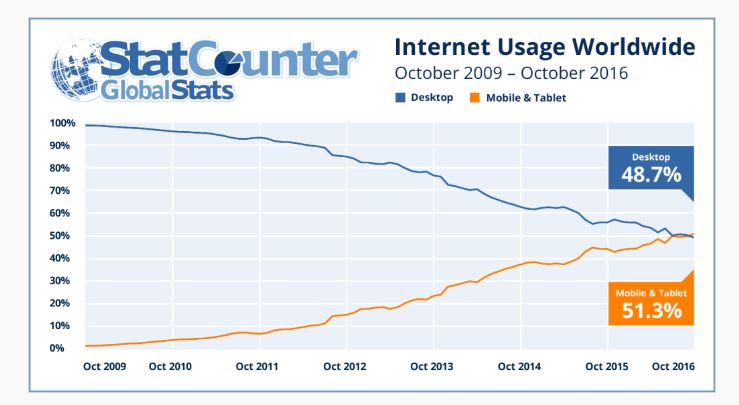
According to data released by StatCounter for October, mobile devices were used more often for web browsing than traditional desktop machines.
The figures show that combined mobile and tablet devices accounted for 51.3 percent of worldwide web use compared to 48.7 percent via desktop.
OK, so there’s only a 2.6% difference overall, but the moment is a very significant one for the world-wide web overall, and it’s a trend that’s unlikely to find itself reversing any time soon.
It should also serve as a wake-up call to any business that hasn’t yet decided to focus on mobile first approaches to doing business in the cloud in the 21st Century. Not only is mobile use going to become increasingly more important as the amount of traffic it generates continues to grow, but Google itself now favours mobile-friendly websites for its mobile search results.
That said, StatCounter’s data also found some interesting demographical (wow, I honestly didn’t think ‘demographical’ would be an actual word!) differences between different global regions. The ‘maturity’ of western based internet markets such as in the UK, the US, and Ireland still see a majority of web traffic being accessed from full blooded desktop machines. In the UK for example, desktop browsing accounted for 55.6% and 58% in the US. (Although the gap is decreasing)
It will come as no surprise that the emergent markets in the world such as India sees mobile web traffic account for 75% of all use as more users seek to use the internet in a cost effective manner.
Google originally identified, helped pioneer, and promote the original trend towards mobile browsing several years ago, and its ranking algorithms have shifted in recent times to favour mobile devices. since accelerated the shift with changes to its search favouring mobile.
While everyone bemoans the slower-than-molasses lag time of an older computer and internet service providers boast about their industry-beating high-speed internet packages, too many tech users overlook one of the most common and easiest culprits in slow hardware: a clogged computer.
Advanced Systemcare is a one-click utility that rids your hard drive of the garbage you don’t need, freeing up disk space and generally keeping things running more smoothly. Now that version 10 is out of its previous public beta round and is ready for download, here are some of the updated features and old mainstays that you can rely on:
Advance system optimization
Privacy protection
FaceID
‘Speed Up’ features
Surfing Protection & Ads Removal
Backup and restore
Privacy Sweep
Some of the more interesting–and admittedly, cautious–features that have been incorporated in this version are involved in user security. In order to offer top-notch protection, the user does have to turn over access to a few key things, like the camera. FaceID is great for blocking unauthorized users from accessing your content, for example, but only if you’ve pre-loaded your own authorized image of your face and if you’ve given access to your camera to the application. At the same time, though, the enhanced browsing and ad blocking in the new version is aimed at keeping prying eyes out of your web-based business.
One of the things that initially made Advanced Systemcare’s previous versions popular with tech users is still in place, and that’s its ability to monitor RAM, CPU, and disk space in real time. Once this feature is enabled, users can see what tasks are chewing up space and processing speeds and either end them or work with them. A simple click provides a key look at where the holdup might be. Coupled with the ability to fully clean out any unnecessary programs, such as those that come packaged or bundled with drivers or updates, Advanced Systemcare works to ensure your hardware is up to speed.
Facebook has seen its desktop ad revenue grow by 18% compared to this time last year, and has said that bypassing ad blockers is the root reason for the increase in profits.
“On ad blocking, in terms of the impact I would just point out that this quarter we had 18 percent year-over-year desktop revenue growth. If you look at recent quarters, it was about half of that growth rate on a year-over-year basis. So, that increment, that acceleration in desktop revenue growth is largely due to our efforts on reducing the impact of ad blocking. So, that’s what led to the acceleration of desktop revenue growth.”said Facebook CFO, David Wehner.
Facebook currently makes around 85% of its revenue via mobile devices, but its use on desktop still managed to pull in an impressive billion dollars plus in the last quarter.
As we here at FileHippo reported back in August, Facebook went to some lengths to stop users with ad-blocking software from not displaying ads, making it tougher for ad-blocking software such as AdBlock, to distinguish between ordinary posts, status updates and ads. The move showed just how seriously Facebook was and is taking the rise of ad-blocking software, and also just how fiercely it will fight s to protect its income streams.
Facebook of course doesn’t exactly struggle when it comes to making money from advertising. Between itself and Google, the two companies control an astonishing 64% of online digital advertising.
AdBlock Plus succeeded in initially circumventing the ban by Facebook, but Mark Zuckerberg’s social media titan quickly put paid to that bypassing, and has since managed to keep the ads flowing freely through people’s pages.
The position of Facebook is that advertising is how the company makes money, and that the ads themselves are unobtrusive and it is how they can offer the service for free. Critics, on the other hand argue that Facebook ads are still a distraction, and that ad blockers help people from being tracked on-line and alleviate privacy concerns.
Last Friday, a DDOS attack set off a shockwave of disbelief when internet users couldn’t access some of their typical websites. Some major websites were affected, along with a few others who rely on the same infrastructure provider, Dyn. Dyn reported repeated DDoS attacks that came in one after another, effectively blocking websites with an overload of junky, fake users. Interestingly, there’s a tie-in through the Mirai botnet malware, which infects IoT devices and uses them to assist as some of the junk clogging up the website victims’ servers. (NOTE: That’s a way oversimplification of the process, but this has to keep moving. There’s a great article here and here about how it actually works.)
Now for the fun part: the tinfoil hat speculation. Within hours of the attack, groups were already claiming that Anonymous had launched it in retaliation for Wikileaks head fugitive Julian Asange having his internet access cut off. Then came much speculation that state-sanctioned Russian operatives were behind it in an attempt to interfere with the US Presidential campaign. There is even some connection to a network operators’ conference in Dallas that morning in which the Director of Internet Analysis for Dyn presented a talk on (you guessed it) DDoS attacks; one of the company’s chief data analysts had also beenworking on a blog about the very subjectand its impact on DNS providers like Dyn.
So is this the new future of both the internet and everyday life? A DDoS attack cripples popular websites when the political tides shift, or when your favorite outlaw-in-hiding makes headlines? It very well might be, and it speaks to the need to make serious changes in both online security and consumer reliance on the internet
Banking experts are claiming that several high-profile banks have decided it’s cheaper to pay hackers in bitcoin than deal with damaging and embarrassing cyber attacks.
According to cybersecurity company Malwarebytes, the City of London is a literal ground zerofor ransomware attacks compared to the rest of Europe. The cyber-security firm spent the best part of 2 years studying the online threats different cities in Europe faced, and analysing the degree of risk by recording which destinations received the maximum number attacks or threats. The financial areas of London were found to be targeted again and again.
It found that the City of London suffered 10,500 ransomware attacks, which is 670% more than the second-biggest target, Manchester.
As part of their Disaster recovery plans, Several of London’s largest banks now have a constant supply of bitcoin to hand in the event of a successful attack by cyber criminals.
Ransomware is essentially malicious software that is installed in computer hardware that then encrypts files so that the data it contains can’t be accessed without a specific password or code that only the hacker knows.
In order to access the locked files, the target of the attack, usually has to pay a ransom in bitcoin or face losing their data forever. Once the ransom has been paid, the attacker will normally then send decryption key to unlock the data. But however, there is no guarantee the hacker will send on the unlock code.
Marcin Kleczynski, CEO at Malwarebytes said “I talked to a couple of banks and they say they have 50-100 bitcoin ready at all times in a wallet to deploy if a ransomware attack hits.”
Bitcoin is the currency of choice for hackers because it is virtually untraceable, hence the reason it is being acquired by blue chip companies to pay ransoms.
The American Academy of Paediatrics (AAP) has announced new screen time guidelines for children under three years old
While previously the AAP had advised no screen time for at all for children under the age of 2, the advice has now changed.
The AAP which first issued that recommendation back in the last year of the 20th Century, has now revised and updated its guidelines for both children and their parents in a move that reflects new research and habits.
The new advice is that children aged over 18 months can and should use video chat with family, and watch supervised “high quality” programmes such as Sesame Street until the age of five.
The new guidelines move fully place the emphasis on what children are watching to who they are watching it with. The report reads:
“Families should proactively think about their children’s media use and talk with children about it, because too much media use can mean that children don’t have enough time during the day to play, study, talk, or sleep…What’s most important is that parents be their child’s ‘media mentors’. That means teaching them how to use it as a tool to create, connect and learn.”
The report also focused on the on the importance of physical activity and non-screen face to face interaction, and recommends completely media-free locations in family homes, such as bedrooms and play rooms.
Two- to five-year-olds should be limited to one hour of screen time a day, and “media free times” should be created by carers, the guidelines add.
The report also encourages parents to put their smartphones down when interacting with their children, and make sure they got enough sleep. The importance of media free times were also highly recommended, such as at dinner and also before going to sleep, and stated that media devices should not be present at these social occasions.
Previous studies have shown compelling evidence that too much screen time can negatively affect sleep, promote obesity and depression, and have an overreaching negative impact on childhood development.
Qantas, JetStar, and Virgin Australia take step to snuff out risk of on-board fires
The 3 airlines all cite the smartphone’s potential fire risk as the reason for the ban, which came into effect on Sunday night.
It’s more bad news for Samsung which is currently in the process of recalling its Note handsets. According to sources, around 40 Note 7s have been reported to have caught fire while charging, due to a problem with the lithium ion battery that the Note users.
The problem with Samsung’s flagship device, which was only released earlier this year is expected to cost the company and the manufacturer of the battery in and around a billion US dollars to make right.
The airlines which have made the decision to ban the Note 7 have not been directed to institute the ban on the electronic device by aviation authorities from within the country, but is instead their own choice.
In the US, Alaska Airlines last week opted to start carrying fire proof bags for portable devices that catch fire, but the latest news from the US is that the Federal Aviation Authority might be banning them from US flights as well in the next week.
Qantas states that the total ban on the Samsung Galaxy Note 7 will come into force on all Qantas and Jetstar flights from 12:01 am (AEDT) on Sunday 16 October:
“The ban applies to devices being carried onto the aircraft, in carry-on baggage as well as check-in luggage…Other Samsung devices are not affected.”
While previously, the airlines allowed with the phone to fly as long as it was turned off, now anyone found with the phone in their possession, or in their hand or checked luggage will be denied the right to board.
Watch out, Apple. HP on Wednesday introduced a new generation of premium computer products that could generate the kind of excitement in the market that's usually the domain of the folks at One Infinite Loop.
Among the new HP offerings are a new tablet-laptop convertible, a svelte laptop, an innovative all-in-one model, and a 4k display designed for dual screen setups.
"HP has absolutely raised their bar in design, quality and performance," said Patrick Moorhead, principal analyst at Moor Insights and Strategy.
The new HP machines target the premium end of the PC market, he told.
"The target market for these are consumers who care a lot about design and performance and are willing to pay for it," said Moorhead. "HP has been gaining premium PC market share in U.S. retail, so they must have obviously cracked the code there."
Convertible and Laptop
HP's convertible offering is the Spectre x360 (pictured above), which is 2 millimeters thinner than its predecessor and now weighs less than 3 pounds. It has a 13.3-inch FHD IPS display, four speakers and is offered with either an i5 or an i7 seventh-generation Intel Core processor.
It supports log-in via facial recognition and has up to 15 hours of battery life. What's more, the battery can be charged 90 percent in 90 minutes via a quick-charge function.
The Spectre x360, available immediately, sells for US$1,049.99.
HP Envy Laptop
The Envy will be available Oct. 26 priced at $849.99.
All-In-One and Monitor
The Envy AIO 27 is HP's all-in-one desktop unit. It has a 27-inch QHD 3.6 million-pixel display that is just 15mm thick, because all the computing and storage power resides in the monitor's base.
The display supports a "low blue light" mode for improved eye comfort. The base has a sound bar with four speakers tuned by Bang & Olufsen.
Other features include a webcam that pops into the display when not in use, support for sixth-generation Intel quad core i5 or i7 desktop processors, storage on a solid state drive of up to 256 gigabytes, a hard drive of up to 2 terabytes, and HDMI in and out ports.
The AIO 27 sells for $1,299 and will be available this month.
HP's new monitor is the 27-inch Envy 27. It supports 4K video and has a micro-edge bezel. Its RGB color accuracy exceeds 99 percent and includes a Display Port, HDMI and USB C, which can be used to charge devices.
The Envy 27 will be available Dec. 4 for $499.99.
Apple Dropped the Ball
The new HP offerings meet an unfulfilled need in the market, said Bob O'Donnell, chief analyst at Technalysis Research.
"These are premium-looking and well-configured products," he told "and given how Apple has dropped the ball advancing the Mac, there's an opportunity on the premium side of PCs."
Sinking PC shipments have spurred computer makers to intensify their efforts to impress.
"It's become more incumbent upon the companies staying in the market to drive more profit from the premium end," said Ross Rubin, principal analyst with Reticle Research.
"Of course, Apple has been strong in that segment of the market," he told
However, Apple is expected to pick up the ball again at the end of the month with a refresh of its Macintosh line of computers.
"It's too early to tell if HP has upstaged Apple until we see what Apple comes out with next," Moorhead said. "It does set a higher bar for Apple to cross, though."
Reviving PC Market
PC shipments have been declining for years, although there was a small bump up in this year's second quarter.
PC shipments in the United States jumped 1.4 percent compared with the same period a year ago, reported Gartner, which includes tablets in its tallies.
PC shipments climbed 4.9 percent, according to IDC, which excludes tablets.
Worldwide shipments fell, however -- by 5.2 percent according to Gartner, and by 4.9 percent according to IDC's analysis.
HP and others hope to create some momentum in the market by introducing new premium products capable of generating the kind of excitement that could infect the whole market.
"In aggregate with what Dell and Lenovo have done, HP's new line could breathe some new life into the PC market," Moorhead said.
PCs Not Dead
HP also is hoping the new line can prod consumers to buy a new computer.
"All PC manufacturers are trying to kickstart the replacement market," said Jack E. Gold of J.Gold Associates.
"Everyone says PC's are dead," he told.
"PCs aren't dead. It's just that people are holding onto them for much longer than they have in the past," Gold pointed out.
"Lenovo, HP, Dell -- they're all trying to find ways to bring some excitement back into the market," he said. "They're looking at new form factors and all sorts of things to get consumers to get excited and buy upgrades. It's not a bad strategy."
Will the new HP offerings excite consumers enough to trade in their old PCs?
"It's always a challenge to get people to spend money for tech," Gold acknowledged, "but for those users who have not been upgrading in the past, there's a lot of stuff here to really like."
Red Hat on Wednesday released the beta version of Fedora 25, an open source Linux operating system maintained by the Fedora Project community.
The beta release sharpens cloud and developer features,making this Linux distro more attractive to enterprise users.
Fedora Linux is the community version of Red Hat Enterprise Linux, or RHEL. Fedora 25 is comprised of a set of base packages that form the foundation of three distinct editions -- Cloud, Server and Workstation -- that target different user bases.
They share a common foundation and some common strengths. For instance, all of the Fedora editions are released twice a year to maintain a leading edge without bleeding, according to Fedora Project Leader Mathew Miller.
"Fedora is a fast-moving Linux distro that provides a great window into the thinking of both Red Hat and the global Linux community," said Azul Systems CEO Scott Sellers.
Enterprises and independent software vendors should pay close attention to major releases of Fedora, he told LinuxInsider, because that is where new ideas and new technologies are first introduced, tried and matured before they eventually get supported in commercial offerings like Red Hat Enterprise Linux.
Targeted Users
The Fedora 25 release is particularly noteworthy for enterprise users.
"It is a good way to get a handle on the future," Fedora's Miller told LinuxInsider. "What's more, Fedora is not just a weathervane, and it is certainly not just like getting an early beta."
Fedora 25 is a place where you can shape things, he said, so enterprise users with particular needs can come to Fedora and actually make them happen.
Compelling Reputation
Linux creator Linus Torvalds recently announced his preference for Fedora over other distros -- something for potential adopters to consider.
"Torvalds' endorsement matters, because people in the Linux world care what he thinks," Endpoint Technologies Associates President Roger L. Kay told LinuxInsider.
While appreciated, Torvalds' endorsement is little more than a great trivia point, in Miller's view.
"I'm glad Linus does find Fedora useful," he said. "He's a software developer, and we want Fedora to be a top choice for that."
Fedora serves as an integration point for the innovation going on in all of the various projects in the free and open source software universe, Miller said. The Fedora team takes that code and ensures that it plays nicely together and is easily consumable by users.
Fedora 25 Revealed
Fedora's developers have followed a Fedora.next initiative for the last few years, which created three distinct Fedora Editions to target different specific audiences.
Fedora Workstation targets software developers using Linux on their desktops and laptops.
Fedora Server is aimed at small business and home users who want an easy-to-manage Linux server. It is the community's most direct connection to its downstream enterprise distributions.
The Fedora Cloud edition is designed for users looking to run containerized applications in a scaled-out environment, according to Miller.
One of the most significant changes coming in the final release of Fedora 25 is a change in the Cloud edition. The Atomic Host will replace the Cloud edition still in the Fedora 25 Beta version.
The Atomic Host release will allow users to adjust the configuration to run container-based workloads on both the cloud and bare metal. It has three components: a base image for creating virtual machines; an Atomic Host image for creating hosts for container deployment; and a Docker image.
More Key Changes
Another significant change in the three-pronged Fedora platform is the introduction of Fedora Media Writer, a multiplatform tool for users who want to make their own bootable USB.
Media Writer is available for Windows, OS X and Linux. It makes upgrading the desktop environment to the latest stable version of Fedora easier.
Fedora 25 Server, built around security enhancements, includes an SELinux troubleshoot module for the Cockpit server administration tool. It provides suggestions for a user when an SELinux denial is encountered.
Otherwise, mitigating that problem would require log checking and manual workarounds, according to Miller.
"The advances in Cockpit in Fedora Server are worth keeping an eye on, particularly for small and medium installations," he said. "This is a very slick Web-based systems management interface with a modern design and none of the disadvantages of previous-generation Web-control panels."
Fedora 25 Server beta also brings improved security with support for multifactor authentication services. Also added is new SSH key visibility in the system dashboard.
Fedora 25 Workstation edition adds several major milestones, including the introduction of Wayland as the default display server. Wayland is the replacement for the legacy X11 display system. It provides a much better vehicle for isolating applications from each other and the system, according to the release notes.
Fedora provides alternative desktop environments to the Workstation edition's GNOME default, called "spins." You can replace GNOME with the KDE Plasma, Xfce, LXDE, MATE, Cinnamon or Sugar desktops.
Language Features
Fedora 25 ships with the GNOME 3.22 desktop environment, released last month, as the default choice.
This latest GNOME desktop supports the Flatpack cross-distribution application framework, which permits installation of an application on various Linux distributions without retooling the software for specific package management formats.
Software developers likely will appreciate Fedora 25's updated language support. Among the languages now supported by Fedora is the open source Rust programming language.
The Rust language and its Cargo package management tool enable fast-compiled programming. The process prevents segmentation faults and ensures thread safety. It also supports both functional and imperative procedural paradigms.
Program Packages
The Fedora Project shares the following significant updates:
Docker 1.12 for building and running containerized applications
Node.js 6.5, the latest version of the popular server-side JavaScript engine
Multiple Python versions -- 2.6, 2.7, 3.3, 3.4 and 3.5 -- to help run test suites across several Python configurations, as well as PyPy, PyPy3 and Jython
Software packages include Firefox 49.0 and LibreOffice 5.2.2.
The final version of Fedora 25 is set for release on November 11, 2016.
You can download the latest Beta release here.
Microsoft's Artificial Intelligence and Research Unit earlier this week reported that its speech recognition technology had surpassed the performance of human transcriptionists.
The team last month published a paper describing its system's accuracy, said to be superior to that of IBM's famed Watson artificial intelligence.
The error rate for humans on the widely used NIST 2000 test set is 5.9 percent for the Switchboard portion of the data, and 11.3 percent for the CallHome portion, the team said.
The team improved on the conversational recognition system that outperformed IBM's by about 0.4 percent, it reported.
That improvement is important, noted Anne Moxie, senior analyst at Nucleus Research.
While speech recognition provides an easier way for humans to interact with technology, "it won't see adoption until it has extremely low error rates," she told TechNewsWorld.
Google, IBM and Microsoft are among the companies working on speech recognition systems, but Microsoft is the closest to overcoming the error rate issue, Moxie said. "Therefore, its technology's the most likely to see adoption."
Testing the Technology
The team's progress resulted from the careful engineering and optimization of "convolutional and recurrent neural networks." The basic structures have long been well known but "it is only recently that they have emerged as the best models for speech recognition," its report states.
To measure human performance, the team leveraged an existing pipeline in which Microsoft data is transcribed weekly by a large commercial vendor performing two-pass transcription -- that is, a human transcribes the data from scratch, and then a second listener monitors the data to perform error correction.
The team added NIST 2000 CTS evaluation data to the worklist, giving the transcribers the same audio segments as provided to the speech recognition system -- short sentences or sentence fragments from a signal channel.
For the speech recognition technology, the team used three convolutional neural network (CNN) variants.
One used VGG architecture, which employs smaller filters, is deeper, and applies up to five convolutional layers before pooling.
The second was modeled on the ResNet architecture, which adds a linear transform of each layer's input to its output. The team applied Batch Normalization activations.
The third CNN variation is the LACE (layer-wise context expansion with attention) model. LACE is a time delay neural network (TDNN) variant.
The team also trained a fused model consisting of a combination of a ResNet and a VGG model at the senone posterior level. Senones, which are states within context-dependent phones, are the units for which observation probabilities are computed during automated speech recognition (ASR).
Both base models were independently trained and the score fusion weight then was optimized on development data.
A six-layer bidirectional LSTM was used for spatial smoothing to improve accuracy.
"Our system's performance can be attributed to the systematic use of LSTMs for both acoustic and language modeling as well as CNNs in the acoustic model, and extensive combination of complementary models," the report states.
The Microsoft Cognitive Toolkit
All neural networks in the final system were trained with the Microsoft Cognitive Toolkit (CNTK) on a Linux-based multi-GPU server farm.
CNTK is an open source deep learning toolkit that allows for flexible model definition while scaling very efficiently across multiple GPUs and multiple servers, the team said.
Microsoft earlier this year released CNTK on GitHub, under an open source license.
The Voice
"Voice dictation is no longer just being used for composing text," said Alan Lepofsky, a principal analyst at Constellation Research.
"As chat-centric interfaces become more prevalent, core business processes such as ordering items, entering customer records, booking travel, or interacting with customer service records will all be voice-enabled," he told TechNewsWorld.
To illustrate his point, Lepofsky noted that he had composed his response and emailed it to TechNewsWorld "simply by speaking to my iPad."
The anticipation leading up to Google’s launch of its new smartphone came with mixed speculation. While known for innovation and a game-changing approach to its products, the Pixel and Pixel XL came to market with a cloud of naysaying speculation hanging over its launch.
But now that Pixel is here and has had some time face off against its competitors, one of the most touted features is its camera. In truth, the camera probably isn’t going to be the deciding factor for most consumers when it comes to selecting a smartphone. After all, manufacturers have incorporated some kind of camera since the days of the early flip phones. But it’s certainly a selling point when combined with other comparable features, especially for people who rely on their cameras for work or image-heavy social media activity.
There’s an interesting fact about Pixel’s best-in-class camera, though: it’s really not that awesome. Don’t misunderstand that statement; the Pixel’s ability to produce incredible photographs and HDR images has already been shared far and wide. But as a report on the camera by The Verge–along with a side-by-side review of some of the top smartphone cameras currently available–shows, the camera hardware is only so-so while Google’s software is what makes the magic happen.
Speaking of magic, imagine it like this: you make a pinhole camera from a cardboard box, the kind schoolchildren make is science class or the Scouts. You use it to take a really crummy picture of a leaf. Inside the box, a genie claps his hands together and suddenly your picture is vibrant and more-real-than-real that honeybees swarm to land in its center.
The genie in this case is Google’s software, of course, and it makes so much sense that the powerhouse behind the world’s leading search engine and the world’s most widely used web browser, just to name a few, would approach new hardware from a software standpoint. Why continue to shrink bigger and better components when you can simply make existing hardware work better?
UK Intelligence agencies have been found to have broken privacy rules over the large scale bulk collection of its own citizens data without appropriate legal oversight, the UK’s own Investigatory Powers Tribunal (IPT) has ruled.
The IPT declared in their report that the domestic security agencies not only operated unlawfully but also breached basic domestic human rights laws by collecting large amounts of Internet Service Provider communications traffic, and by also maintaining vast databases of information of individual UK citizens for over 15 years.
The 70 page long ruling states that data collection by MI5, MI6, and GCHQ did not comply with the European Convention on Human Rights, and as such was therefore illegal.
The IPT began their investigation back in 2015 after official complaints were registered against the intelligence agencies by Privacy International.
According to GCHQ, the retention of such data is “vital for identifying and developing intelligence targets.”
According to article 8 of the European Convention on Human Rights however, All European citizens have the right to a private life and any interference with personal data or information has to be both lawful and necessary.
In November of 2015, then Home Secretary (and now Prime Minister) Theresa May revealed that British intelligence agencies had been intercepting bulk communication data of its own citizens for years.
The data collected included visited websites, GPS locations, email metadata, and individual financial and communication activities.
However, the ruling while welcomed by Privacy International as “highly significant judgement,” but that “the authorisation and oversight regime that was left wanting pre-2015 remains deeply inadequate.”
And that’s because despite the IPT findings of illegality, official UK government policy changed in February this year. Now, the collection of data includes official guidelines and offers more disclosure about what can and can’t be collected from individuals. Crucially though, the actual collection of data, the manner in which it is collected, and the underlying covertness of UK intelligence agencies hasn’t changed…
Yes, that’s right, it’s now legal for the UK to spy on its own people
Essentially, the UK government have simply changed the wording on the packaging, which in real terms means that nothing has changed. The UK spy agencies can carry on as they were, and from February this year, it’s all become legal all of a sudden.
Life for anyone involved with the troubled former internet titan, Yahoo, is continuing to get worse.
With a recent history of failed spinoffs, strategic blunders, falling market share, and a continual brain drain as employees jump ship to competitors, it now also seems that Verizon’s $4.8 billion bid for the beleaguered company that was once valued at $100, 000, 000, 000, is also floundering.
The latest setback for the Verizon acquisition is from further fall out from the massive data breach thatoccurred2 years ago, when 500 million Yahoo users’ login account information was stolen.
While no one seems to now be disputing that Yahoo itself only realised the scale of the hack in July, exactly when in July they discovered the breach now seems to have come into question.
It was on July 25th that Verizon agreed to buy Yahoo, lock stock, and barrel. But Yahoo only fully disclosed the breach to Verizon and the public at large in September.
A-Ha!
Quite.
Verizon may now appear to be using that fact as grounds to either buy Yahoo at a much greater discount than the near $5 billion that was agreed, or even call time on the deal altogether.
The company has reportedly sought a billion-dollar discount on its pricey acquisition. The telecoms company is now sending signals that it may try to scuttle the deal altogether.
A Verizon lawyer told reporters: “I think we have a reasonable basis to believe right now that the impact is material and we’re looking to Yahoo to demonstrate to us the full impact. If they believe that it’s not, then they’ll need to show us that.”
The news couldn’t come at a worse time for Yahoo. Research firm, eMarketer is set to announce a double-digit decline in ad revenue for this year, while on Friday, chief executive officer Marissa Mayer cancelled a routine results call with analysts.
Facial recognition software is the eerie stuff of Hollywood cyberthrillers, and interestingly, it always seems to be the “good guys” who are using it badly. The rogue hero somehow manages to thwart their efforts by ducking and weaving through a crowded metro station while the suddenly inept cops can’t find him with their futuristic gadgets.
The real-world application of facial recognition software is a little more mundane, though. Recently,this type of tool was put into useat an outdoor music festival, but not for crowd control or seeking out potential terrorists. The organizers allowed festival-goers to voluntarily opt in to have their faces scanned, and used that information to send them photos of themselves at the concert after if it was over. Attendees sent in a selfie from their phones, and the organizers used the software to find those faces in the crowd then send them their pictures.
But public users in Russia recently found another fun use for facial recognition software, especially when it was paired with an extensive database of users’ images through a site similar to Facebook. There, users with an ax to grind cross-referenced photos that individuals had shared over social media and compared them to faces from porn films and photos, then contacted those individuals to harass and extort them.
Being tracked by the authorities in public places thanks to your facial features is scary enough, but the more plausible and realistic threat of having your past come back to haunt you in a serious way is far more frightening to many people. Thanks to modern-day tools like social media and smartphones, this reality is hitting closer to home for a lot of people.